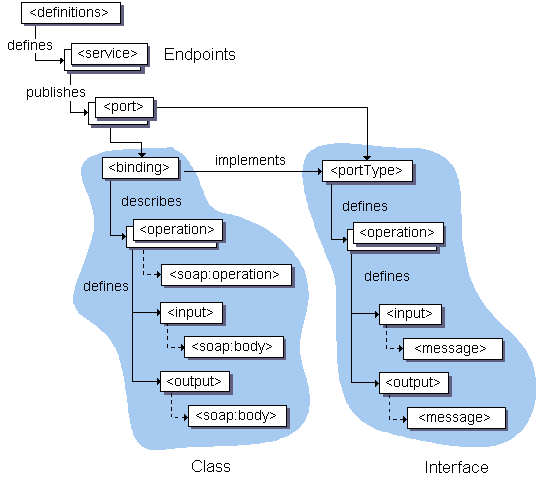
Web Services Description Language (WSDL) is an XML grammar for describing network services as collections of communication endpoints capable of exchanging messages. The diagram below illustrates the elements that are present in a WSDL document, and indicates their relationships. To see an example of how this is implemented in a WSDL document, refer to the Example of a WSDL Document.
A WSDL document has a definitions element that contains the other five elements, types, message, portType, binding and service. The following sections describe the features of the generated client code.
WSDL supports the XML Schemas specification (XSD) as its type system.
name is optional.targetNamespace is the logical namespace for information
about this service. WSDL documents can import other WSDL documents, and
setting targetNamespace to a unique value ensures that the namespaces
do not clash.xmlns is the default namespace of the WSDL document, and
it is set to http://schemas.xmlsoap.org/wsdl/. <definitions>, <types>
and <message> reside in this namespace. xmlns:xsd and xmlns:soap are standard namespace
definitions that are used for specifying SOAP-specific information as
well as data types.xmlns:tns stands for this namespace.xmlns:ns1 is set to the value of the schema targetNamespace,
in the <types> section.